
Hold Fast: Dame Flora, the Dark MacLeod Tartan, and a Wedding Present
Flora MacLeod was born in 1878 at 10 Downing Street, which is not where Highland chiefs usually start. Her grandfather was Chancellor of the Exchequer and the family was staying with him. She grew up between London and the Continent, married a journalist, raised two daughters, served on Inverness County Council, and by the ordinary reckoning of the time was approaching the end of a useful life when, in 1935, her father died and she inherited a castle.
She was fifty-seven. The castle was Dunvegan, on the Isle of Skye, a great grey block on a rock above a sea loch, which had been the home of the chiefs of MacLeod for something like eight hundred years. With it came the chiefship itself. She was the twenty-eighth of her line. Her branch of the clan had its own cloth, the dark MacLeod of Harris tartan, and it is the one this story follows.
What she did next changed what a clan is.
The castle and the flag
To understand what Flora inherited you have to know a little about what was inside.
The MacLeods descend from Leod, a thirteenth-century lord of mixed Norse and Gaelic blood who held Skye, Harris and Lewis under the kings of Man. His two sons founded the two branches of the clan. From Tormod came the MacLeods of Harris and Dunvegan. From Torquil came the MacLeods of Lewis. The Lewis line was destroyed in the early 1600s. The Harris line held fast, which became the family motto, and never left Dunvegan.
In the castle are three treasures. There is a great ox horn rimmed with silver, which each new chief was once expected to drain of claret in a single draught. There is a medieval wooden cup cased in silver. And there is a square of very old, very fragile yellow-brown silk, patched and darned, that the clan calls Am Bratach Sìth, the Fairy Flag.
There are several stories about the flag. In one, a chief married a fairy woman, and when she was called back to her own people after twenty years she left it as a parting gift at the place still called the Fairy Bridge. In another, a MacLeod brought it home from a crusade. Experts who examined it thought the silk was from the eastern Mediterranean and extremely old. The tradition is that the flag may be unfurled three times to save the clan from disaster, and that it has been used twice. During the Second World War, it is said, young MacLeods serving in the Royal Air Force carried its photograph in their wallets.
This was the inheritance: a fortress, a legend, an estate that did not pay, and a clan that no longer lived anywhere near it. The MacLeods had been leaving Skye for two hundred years, pushed out by rent and famine. There were far more of them in North Carolina, Nova Scotia, Ontario, Australia and New Zealand than in the Hebrides.
Forty years on the road
Flora decided that if the clan could not come to Dunvegan, Dunvegan would go to the clan.
After the war, already in her seventies, she began to travel. She went to the United States and Canada, to Australia and New Zealand, again and again, staying in the spare rooms of people called MacLeod, speaking in church halls, founding clan societies wherever she stopped. She told everyone she met the same thing: that they belonged to a family, that the family had a home, and that they would be welcome there.
People who met her remembered a small, upright, white-haired woman with a formidable memory for names. She was made a Dame in 1953. In 1956 she called the clan home for the first Clan Parliament, a gathering of MacLeods from all over the world at Dunvegan, which has been held every few years since. She kept travelling into her nineties. She died in 1976 at the age of ninety-eight, and was succeeded by her grandson.
Before Dame Flora, a clan was mostly a matter of history. After her, it was a worldwide network of living people who wrote to each other, visited each other, and felt they belonged to something. A good many of the clan societies active today owe something to her example. And it is largely because of her that so many households at the far ends of the earth keep something in MacLeod tartan in the house.
Loud and quiet
Which MacLeod tartan is the question, because the clan has two and they could hardly be less alike.
The famous one is yellow. MacLeod of Lewis is a blazing field of yellow crossed with broad black bars and a thin red line, and it has been known for generations as the Loud MacLeod. It entered the record in a letter to Sir Walter Scott in 1829, describing a pattern of “three black stripes upon a yellow field,” and was published in 1842. It is magnificent and you can see it from the far side of a loch.
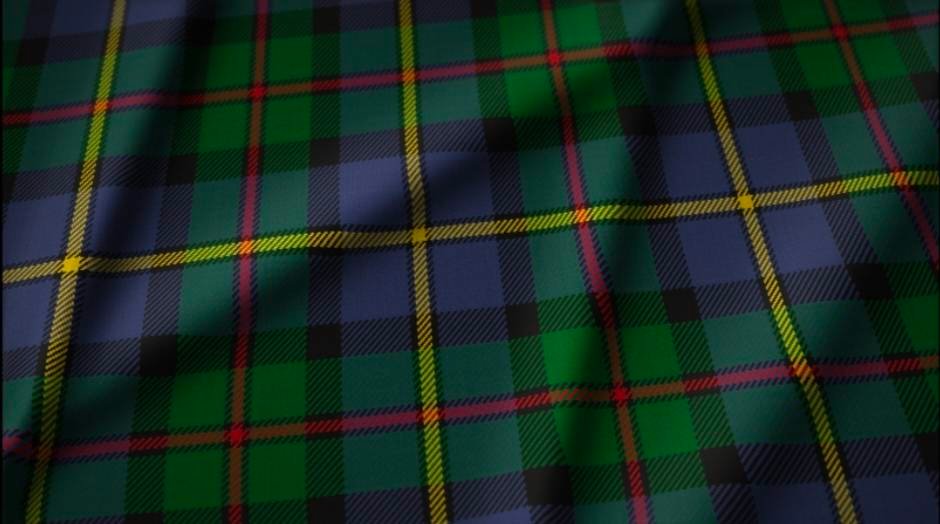
The other belongs to Dame Flora’s branch. The MacLeod of Harris tartan is a dark cloth of blue, green and black, crossed by one fine line of yellow and one of red. Tartan scholars have long noticed that it is almost the twin of the MacKenzie, with yellow where MacKenzie has white. The usual explanation goes back to 1777, when John Mackenzie, who held the courtesy title Lord MacLeod, raised a Highland regiment known as MacLeod’s Highlanders. Its tartan was the army’s dark Government sett with coloured lines added, and the MacLeod pattern looks like a close relation with the yellow put in to mark the difference. A version is recorded in the collections of 1906 and, according to the archive notes, in the Bannockburn weavers’ books a century before. It is a tartan that wears well at home, too: the dark cloth makes a plaid pillow that hides the life of a family sofa.
There is an older MacLeod picture still. In the late 1740s, just after Highland dress had been banned, the twenty-second chief sat to the painter Allan Ramsay in a suit of red and black tartan. He was a Member of Parliament and had voted against the ban. The portrait hangs at Dunvegan. The cloth in it is neither of the modern tartans, which is a useful reminder that the patterns we know were fixed later than people think.
Today most of the clan wear the Harris sett for everyday and formal use and keep the yellow for when they want to be noticed. Retailers list them together, in Modern, Ancient and Weathered colours, as kilts, skirts, waistcoats, scarves and cloth by the yard.
A parcel for Christchurch
Now a kitchen table in Dunedin, in the South Island of New Zealand, where the Scots settled so thickly that the city is named for Edinburgh.
Margaret is seventy-one. She is the keeper of the family’s history, the one with the box of photographs and the membership of the clan society, which her mother joined after Dame Flora came through on one of her tours. Her mother shook the old lady’s hand and talked about it for the rest of her life.
Margaret’s nephew is getting married in Christchurch in March. His bride’s people are Frasers. Margaret wants to give them something that says where they come from, and she has been turning it over for weeks.
A kilt is too much. It costs a great deal, needs measurements, and he would wear it twice. The clan-crest mug and the fridge magnet are too little. She wants something made from the real cloth that they will actually use.
What she settles on is cushions. She has found a Highland-wear maker that will sew a plaid pillow cover in any of several thousand tartans, so she can have the family’s own sett and not some department-store check. No sizes to guess. Nothing to try on. It will sit on their sofa every day without anyone having to make an occasion of it.
She spends a while on the colour. The Loud MacLeod would be a statement, and she is fond of it, but it would take over a room, and she does not know the bride’s taste. The Harris is safe with anything. Navy, green and black will sit on a grey sofa or a tan leather one. And the two fine lines, the yellow and the red, will pick up whatever else is in the room: a brass lamp, the spines of books, a rug. She orders a pair in the Harris. Then, because it is a marriage and there are two families in it, she orders a second pair in the Fraser.
She knows the rule about these things, which is that two or three tartan cushions in a room look deliberate and six look like a gift shop. Four is pushing it. They can put two in the bedroom.
The covers come with zips, so they can be washed. She buys feather inserts a size larger than the covers so they sit plump. The pattern is woven into the cloth and not printed on it, so it will look the same in twenty years. She wraps them in tissue, and on the card she writes the two mottoes. Hold Fast, for the MacLeods. Je suis prest, I am ready, for the Frasers. It seems to her as good advice for a marriage as any.
What she understood
Dame Flora’s great insight was that a clan could lose its land and keep its life, as long as its people went on feeling that they belonged. She also understood that belonging is not kept alive by the grand occasions alone. It is kept alive by small, repeated, ordinary things: a letter, a visit, a name passed to a child, an object in the house that tells a story when a visitor asks about it.
The Fairy Flag stays in its frame at Dunvegan, waiting for the third emergency. The kilt comes out for weddings and funerals. But on a wet Tuesday evening in Christchurch, years from now, a child will be leaning on a dark blue and green cushion with a thread of yellow in it, and will ask what the pattern is. Somebody will tell her about a castle on a rock, and a flag a fairy left, and a small white-haired woman who spent forty years travelling the world to tell people they belonged to a family.